
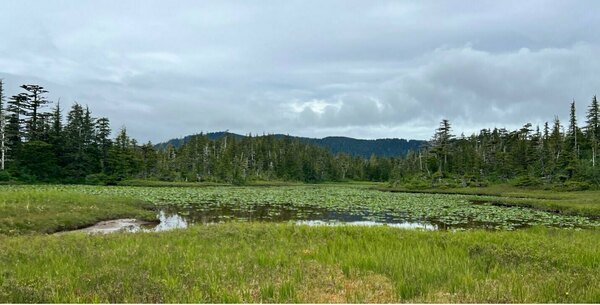
Shallow freshwater ponds in coastal Alaskan wetlands are getting warmer in sync with rising air temperatures, according to a study by University of Notre Dame researchers, signaling that the area could potentially become unsuitable for salmon and other organisms during this century.
The article in Nature Communications Earth & Environment by Gary Lamberti, professor emeritus at Notre Dame and affiliated faculty member with the Notre Dame Environmental Change Initiative (ND-ECI), and lead author Amaryllis Adey, who earned her doctorate at Notre Dame and is now a postdoctoral researcher at Virginia Tech, shows that these critical wetland ecosystems do not have the thermal buffer that rivers or deeper lakes have, and react quickly to temperature changes. Even conservative scenarios show that the ponds could warm by more than 7 to 11 degrees fahrenheit by the end of this century.
The reason is fairly apparent, according to Lamberti: “A large bowl of water, like one of the Great Lakes, is harder to warm than a shallow plate of water like a wetland.”
For their work, the researchers relied on temperature loggers installed in 2012 by the U.S. Forest Service in southcentral Alaska. The area, so remote that researchers must use airboats to reach it, is a nursery for several species of salmon. These salmon use the shallow ponds to grow before migrating to the ocean, through a series of interconnected ponds during high flow. The loggers showed that pond temperature tracked air temperature almost perfectly.
To extrapolate the data into the future, the team used climate modeling techniques to project temperature scenarios over time. Their calculations show that the wetlands have an 80-90 percent chance of exceeding the temperature threshold of 68 degrees for salmon growth during some times of the year. Unless salmon rapidly adapt, or the other species that the salmon rely on for food adapt, the salmon will be unable to use those wetlands above that temperature.
“If temperatures reach projected highs, salmon will cease to grow . . . and in the most aggressive or dire scenario, they will die,” Lamberti said.
Though the researchers completed the study in Alaska, many arctic and subarctic wetlands may face the same stress. While people in some parts of the world won’t always notice the effects of a warming climate, the North and South poles experience warming much quicker, Lamberti said. Called “arctic amplification,” the loss of snow and ice exposes darker ground and water that will absorb solar radiation instead of reflecting it. This effect warms the land at a faster rate.
Additionally, the delay of ice formation compresses the winter season, which can impact the interactions of different species. Migratory birds and even wolves use the frozen, shallow ponds as corridors, so losing the frozen ponds impacts more than the salmon.
Lamberti and Adey also noted that warmer ponds will lead to economic and cultural loss. Salmon are more valuable to the Alaskan economy than timber, Lamberti said, so the loss of the habitats could be devastating.
“Salmon also represent a really important tribal resource,” Adey said. “If you’re losing this ecological species that is really important to people, there are far-reaching effects.”
Although the research results concern Adey and Lamberti, they find some room for optimism. The salmon might adapt their behavior to the warmer ponds, or, over time, they might even evolve genetically to tolerate higher temperatures.
“Fish won’t be able to adapt quite that much, but they might shift their spawning time to slightly earlier in the season to hit the colder temperatures,” Adey said. “Ultimately, however, the key is to slow the rate of climate warming,” noted Lamberti.
The study serves as a reminder that the cascading effects of a warming world might result in loss of pristine places that are important not only to a variety of species, but are also important to sportsmen and women and other nature lovers.
“If you appreciate the image of salmon splashing up a waterfall and being grabbed by bears, that image is being threatened by these temperature changes,” Lamberti said.The research was supported by a USDA Forest Service cooperative research agreement and by the Colleges of Science and Engineering at Notre Dame.
Originally published by at science.nd.edu on March 03, 2026.