
Robbi competes sucessfully for the prestigious F31 fellowship from NIH
Back in December, Robbi submitted her application for an F31 fellowship to NIH, with the sponsorship of Felipe and supported by Drs. Smith, Adams, and McDowell. In May, she received outstanding reviews, with an impact score of 24 for a 15 percentile. For the unfamiliar, the percentile score ranks your application relative to all other applications reviewed by the current study section and the prior three meetings. Thus, if there were 100 aplications, Robbi's application scored better than the remaining 85. A great score without a doubt - yet it doesn't mean she was going to get it! Now, she has officially received the Notice of Award of her F31 - congratulations Robbi!
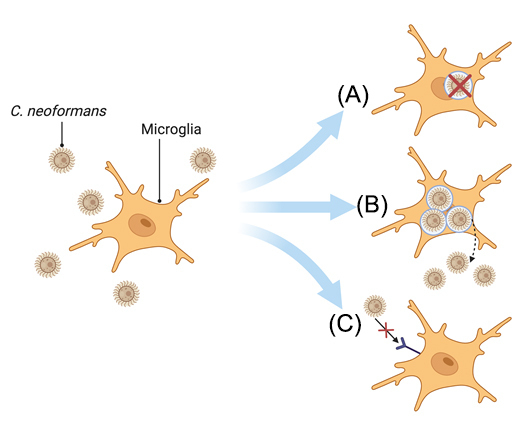
Ever since Robbi joined the lab, she has worked on several projects, but her main thesis project, which formed the basis of this proposal, is to study the host interactions between the fungus Cryptococcus neoformans and microglia (Figure 1). C. neoformans is an environmental yeast with a worldwide distribution, hence most of the population is exposed to it frequently. Healthy individuals get infected but are able to control or clear the infection without exhibiting any symptoms. However, under conditions of immunocompromise, the fungus disseminates from the lungs with special predilection for the brain, causing a brain infection that is very challenging to treat. The latest estimates are that there are close to 200,000 cases yearly, resulting in 150,000 deaths. This high mortality is due to many factors, including a lack of effective antifungals, and an incomplete understanding of the host-cryptococcal interactions - particularly at the brain, which is the site of the fatal pathology, and is the focus of Robbi's application. In this proposal, Robbi will test her hypothesis that C. neoformans survives in the brain using novel, brain-specific, mechanisms as well as other more broad, general mechanisms. She will be using an immortalized human microglia cell line to study the interactions, which then can be validated in vivo using mouse models.
As explained by NIH, the purpose of the NRSA program is "to enable promising predoctoral students with potential to develop into a productive, independent research scientists, to obtain mentored research training while conducting dissertation research." Robbi was described as an "outstanding applicant with an exceptional academic record; evidence of peer review publications (2 first author); conference presentations and complimentary letters of support" and that "the fellowship is highly likely to lead her to an independent career as a biomedical scientist in infectious diseases." We couldn't agree more with that summary! Congratulations Robbi!
Originally published by at fungilab.nd.edu on August 19, 2025.