
This story is part of Notre Dame Global's series titled "Women Who Inspire."

Jennifer Robichaud had a plan for her life. After attending college in her home state of Minnesota, she had plans to go into medicine and become a physician. Knowing how competitive it is to get into medical school, she made a logical decision. To ensure she’d have a job to land on just in case, she chose clinical laboratory science as her undergraduate major. That way, she’d already have relevant experience and skills if she got into med school, and if not, she’d be able to find a job working in a hospital while she waited for the med school door to open.
But she quickly realized that the longer you wait in front of closed doors, the more opportunities you miss. So, she made another logical decision.
“I pivoted,” she says. After graduating with her degree, she went to the University of Georgia to pursue a master’s in their medical microbiology program. “I used my major to bridge a few different things,” she says, explaining how her ability to draw blood came in handy when working with an epidemiology professor on his rabies vaccine trials. By way of that professor’s connections, she was able to carry out her master’s research at the Center for Disease Control (CDC)—“that was pretty fantastic”—on bacteria that was affecting homeless populations and causing heart disease.
These projects were her introduction to public health—an area she would go on to spend her career working in, despite not having a public health degree. Driving it all was the same desire that had originally made her want to pursue medical school: the call to serve.
After getting her master’s, Jennifer stayed in Georgia to carry out research on tuberculosis at the CDC through their Emerging Infectious Disease Laboratory Program. She shares that she’s most drawn to research that can directly apply to helping people, and a lot of times, that means studying germs, which doesn’t bother her in the least. “I like germs, I like gross, weird things,” she shares. “Between tuberculosis and parasites, that’s my jam”—exactly what you want to hear from someone who is actively teaching the next generation of researchers and public health professionals.
She ended up at Purdue, first as a research assistant and then as an instructor. Along the way, she met her husband, they started their family, and then they moved to South Bend for her husband’s postdoc at Notre Dame. What was intended to be a three-year stay turned into 20.
At first, Jennifer thought she’d be taking a hiatus from teaching, as they had a two-year-old and a six-month-old. But a door opened, and naturally, Jennifer knew she had to explore it. “An opportunity to teach parasitology came up here, and then I filled in for a maternity leave in intro bio, and then another course, and then another course, and now I’m the director of undergraduate studies and advisor for the biology program,” she laughs.
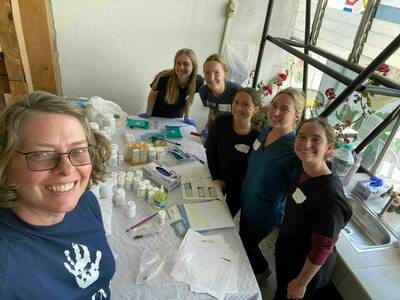
Jennifer leads a medical brigade to Ecuador with students.
While Jennifer loves working with germs and parasites, working with students has proven to be even more of a passion for her. “The lab is a great way of having one-on-ones with students because you teach them a technique, then they’re doing it, then you have this time to chat with and get to know them,” she says. “It carries over to other teaching moments in the lab.”
She also finds great joy in helping students make a real difference in their community. For nearly five years, Jennifer has teamed up with St. Joseph County to do mosquito surveillance. Every summer, she leads students in carrying out mosquito collections and identification, and then the county helps with the pathogen identification for West Nile and Eastern Equine encephalitis.
“We pretty significantly contribute to a lot of the vector surveillance for Indiana because of what we send in,” Jennifer proudly shares. “Being able to contribute to the public health of our county has been really impactful, and the students recognize that.”
Jennifer is coming up on another exciting teaching opportunity this summer: a course at Notre Dame Kylemore. The idea came up when she met Lisa Caulfield, director of Notre Dame Kylemore, a few years ago, and Lisa expressed an interest in having a science course at Kylemore. Known for its beauty and remote, picturesque location, Kylemore Abbey has proved to be an excellent location for art and creative writing programs. But Lisa recognized there was also a great opportunity for science courses, and given the presence of sheep farms in the area, Jennifer’s expertise in veterinary parasitology was a perfect match.
The course will follow a similar structure as Jennifer’s parasitology class here on campus but with an Irish twist. She’ll lead students through examining parasites’ life cycles, how they cause disease, and how to treat and control them, and they’ll specifically look into the parasites that affect sheep farmers.

“I try to go beyond the basics and look at the impact that the parasite has on the particular community,” she says, noting how things like socioeconomic status and other social determinants of health play a role in the discussion as well.
Curating her classes to the local environment is just one way that Jennifer makes coursework more dynamic and engaging for her students. She believes it’s important to expose her students to as many learning opportunities as possible—not only to enhance their academics but also to help them determine what they’re interested in pursuing.
“Some people aren’t quite sure what they want, so getting a variety of experiences is really key,” she says, sharing how she encourages her students to “look for those open doors—there might be opportunities outside the box.” Jennifer’s advice is backed by her experience. It was her willingness to walk through open doors that led her to a fulfilling career in public health. It was an open door that led her to teaching at Notre Dame and connecting with students who fondly call her “JRo.” Jennifer exemplifies that saying yes to opportunity when it comes knocking takes courage to face the unknown, trust in oneself, and hope that what lies on the other side is something worth exploring.
Originally published by at global.nd.edu on March 18, 2025.